I was halfway through a bestselling fantasy novel — the kind that sweeps you up like you’ve fallen straight into another world — when it happened. One minute, I was blissfully lost in the magic. The next, my brain did that rude little thing where it taps you on the shoulder and whispers:
“Okay, but why would anyone read your books when this exists?”
Ah yes. A light snack of emotional devastation to pair with my coffee.
I kept reading, of course. But now I wasn’t simply enjoying an excellent novel. I was running a mental comparison marathon I did not sign up for. Every elegant sentence mocked me. Every clever plot twist felt like a cosmic reminder that my own drafts were… well… still drafts. Ugly, needy, chaotic drafts.
I wanted to sink into the couch cushions, dissolve into mist, and let the dog take my place in society.
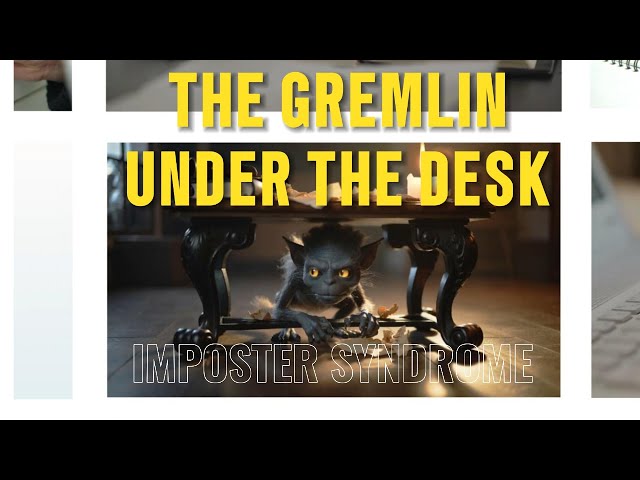
And if you’ve ever felt that sudden, sinking pit in your stomach while reading someone else’s brilliance — welcome. You’ve just encountered the monster under the desk.
Mine has been with me for years, and let me tell you, it has opinions.
But before you panic, let me introduce you to the rude little gremlin that keeps trying to convince you you’re not good enough — and more importantly, how to outsmart it.
Meet the Monster: Your Imposter Syndrome in a Ridiculous Costume
Here’s the truth: imposter syndrome never shows up dramatically. It doesn’t kick your door open, howl at the moon, or leave muddy footprints on your manuscript.
It’s sneakier than that.
It lives under your desk.
Right by your foot.
Munching on the crumbs of your confidence.
Mine has a personality: a slightly grumpy trickster who gnaws on my self-esteem whenever I start feeling hopeful.
It whispers during the worst possible moments:
- when I’m drafting
- when I’m editing
- when I upload something
- when someone compliments my writing (rude)
- when I start reading someone else’s great work
- when I dare to feel proud
If your monster sounds similar, congratulations. You have a fully operational creative brain.
Welcome to the club none of us asked to join.
The Psychology Behind the Monster: Your Brain Is Pulling a Prank on You
Imposter syndrome isn’t a personal failing — it’s a glitch in the human operating system. Here’s why your brain behaves like a dramatic Victorian aunt who thinks everything is a catastrophe:
Cognitive Distortions
Your brain loves exaggeration.
Just loves it.
It takes a single uncomfortable moment and turns it into an entire opera.
Catastrophizing (“I’m terrible at everything”), black-and-white thinking (“Either I’m a genius or I’m useless”), and discounting accomplishments (“It was just luck”) are all favorite weapons of the monster.
Social Comparison Theory
Humans naturally rank themselves.
Writers take it personally.
It’s not enough for us to admire a great book.
We immediately use it as a yardstick to measure our entire existence.
The Competence-Confidence Gap
The more skilled you become, the more aware you are of everything you don’t know.
Beginners are often confident.
Experts often feel like frauds.
Congratulations again — you’re feeling this because you’re improving.
The Fear of Being Seen
Writers want readers.
Writers also panic about being judged.
This psychological contradiction fuels the monster like a double-shot espresso.
Why Writers Are Especially Vulnerable: Our Imaginations Betray Us
Normal people have regular brains.
Writers have overactive ones that build fictional worlds… and then turn that same power inward.
We can imagine other planets, forgotten gods, intricate magic systems — yet somehow we weaponize this skill against ourselves.
Writers are more vulnerable because:
- we compare our messy draft to someone else’s polished book
- we’re sensitive to rejection (because duh)
- we crave validation but fear exposure
- we have perfectionist tendencies
- we overthink everything
- we’re experts at catastrophizing in stunning narrative detail
In other words, we’re delicious prey for the monster.
The Monster’s Favorite Lies: A Greatest Hits Collection of Self-Doubt
If any of these feel familiar, your monster is reading from the same script as mine:
- “Everyone else writes better than I do.”
- “My success was a fluke.”
- “If people read my book, they’ll realize I have no idea what I’m doing.”
- “A real writer wouldn’t struggle this much.”
- “If this draft isn’t perfect, I’m failing.”
These are not truths.
These are lies wrapped in fear, sprinkled with childhood conditioning, and delivered with the confidence of a gremlin who’s never published a word.
How to Outsmart the Monster: A Five-Step Gremlin-Taming Protocol
Imposter syndrome is sneaky — but not invincible. Here’s how to outmaneuver it with strategy and a little humor.
1. Name Your Monster
Seriously. Give it a name.
Mine is “Gerald.”
He has strong opinions and questionable hygiene.
Naming your monster gives you distance — and makes it harder to take seriously.
2. Collect Receipts
Start a “Victory Log.”
Every compliment.
Every good review.
Every finished chapter.
Every time someone tells you your writing mattered.
Your monster hates evidence.
Keep receipts.
3. Reframe the Lies
Take the lie and rewrite the truth beneath it.
“I only got lucky” becomes “I worked hard for this.”
“Everyone writes better” becomes “Every writer has a unique voice.”
“I’m not good enough” becomes “I’m still growing — and that’s normal.”
Reframing doesn’t invalidate the fear.
It contextualizes it.
4. Compare Fairly (Or Not at All)
Stop comparing your draft to someone else’s final book.
You’re comparing a behind-the-scenes rehearsal to a polished performance.
Your first draft is not a failure — it’s a beginning.
5. Keep Creating Anyway
Courage isn’t confidence.
Courage is action in the presence of insecurity.
If you wait until you feel “ready,” you will never write anything.
Write scared.
Write uncertain.
Write imperfectly.
But write.
Your monster can mutter from under the desk — let it.
Just don’t hand it your keyboard.
A Personal Reversal: What I Realized After My Own Meltdown
After I finished spiraling over that bestselling novel — after the comparison, the self-doubt, the internal debate about becoming a decorative house fern — I finally remembered something important:
That author didn’t succeed because they were me.
And I didn’t fail because I wasn’t them.
Their brilliance doesn’t diminish mine.
Their success doesn’t overshadow my stories.
Their path doesn’t erase mine.
We’re different writers with different histories, truths, obsessions, voices, and scars.
There are readers out there who want exactly what I bring to the table — not an imitation of someone else.
And the same is true for you.
You don’t need to match another author’s voice.
You don’t need to out-prose or out-plot anyone.
You just need to write the story only you can write.
There’s room.
There’s space.
There’s an audience waiting.
Final Encouragement: Check Under Your Desk One More Time
The monster under the desk isn’t going anywhere — not entirely.
As long as you’re growing, learning, stretching, and creating, it will occasionally pop up to remind you of your humanity.
But it doesn’t get to run your writing life.
You do.
So if you hear the monster again — if it whispers, nags, sulks, or chews on your courage — take a breath.
Give it a snack.
Pat it gently on its ridiculous little head.
And keep writing.
You’re doing better than you think.
Far better.
Your voice matters.
Your stories matter.
And no bestselling novel, gremlin, or moment of self-doubt can take that from you.
Get a PDF Copy of this blog: