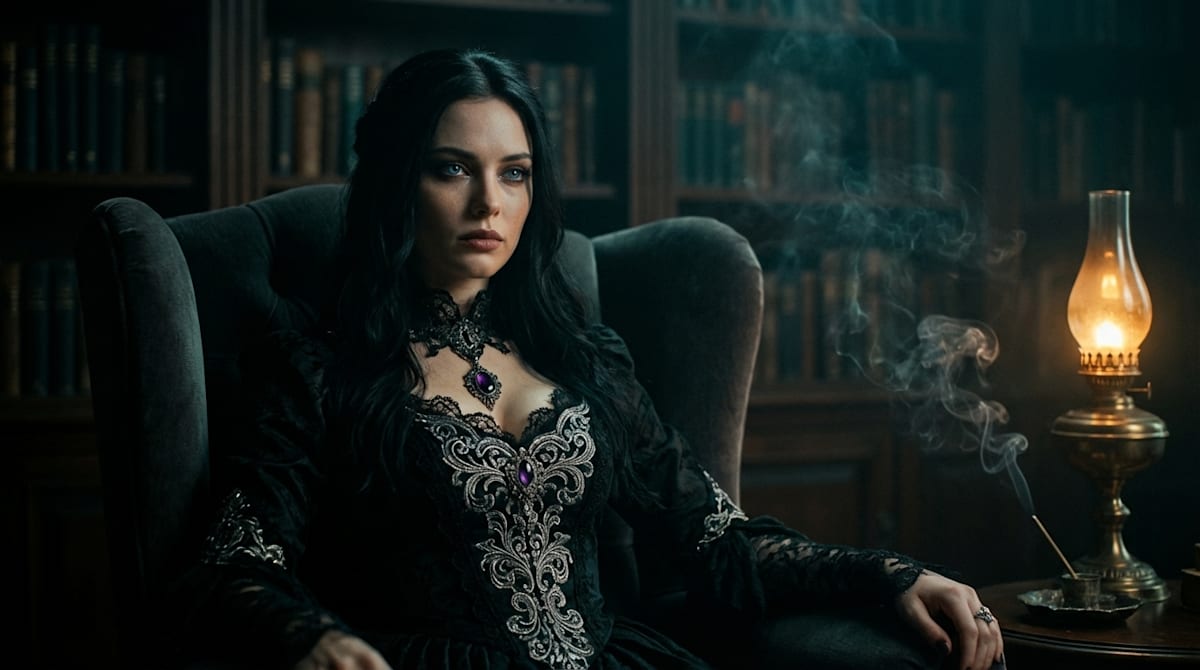
The Crooked Candle is closed, which apparently is the only time its owner agrees to interviews. The bar is all shadowed corners and watchful candle flames, like the room itself is holding its breath to see what she’ll say. Amara sits opposite, undead and unimpressed, a glass of something that looks like whiskey and winter frost in her hand.
The candles, by the way, are listening. She swears they gossip.
Meet Amara (Reluctantly)
Q: For readers just meeting you: who are you when you’re not terrifying merchants and emotionally scarring your candle collection?
Amara: Undead witch, reluctant hostess, and full‑time reminder that political ambition can, in fact, kill you. I own The Crooked Candle, a bar in Nocturne Alley where the living come to drink and the dead come to…linger. I did not choose the undead life. The undead life shot me in the chest with an alabaster bow and then refused to let go.
I was a very respectable witch once. Powerful, ambitious, annoyingly alive. Now I’m mostly frostbite in a corset and questionable coping mechanisms.
Q: And the scar you keep pressing your hand over?
Amara: Ah, my charming party favor. An alabaster arrow, courtesy of someone I called friend. You know the type—smiles too perfectly, says power should be “centralized,” then shoots you through the heart at a political gathering. It killed me and…didn’t.
The scar never warms. It throbs when trouble walks in. Or when the Alabaster Order is near. Or when someone misuses the word “ally.”
On Being Undead (And Inconveniently Aware)
Q: What does undeath actually feel like, on a Tuesday at 3 a.m.?
Amara: Like your blood has been replaced with chilled ink and unfinished grudges.
Physically?
- Everything is slightly too cold. My breath fogs in a room that’s perfectly warm for everyone else.
- Frost blooms where my fingers touch wood and glass; the bar is half-ice sculpture by closing time.
- My magic runs through candles now. They flare with my temper, dim with my grief, and sometimes weep black wax when I think about the night I died.
Emotionally?
You know that moment when you realize the room full of people you trusted voted you expendable? Stretch that into a century and add a bow-shaped scar. That.
Q: You joke about it a lot. Is that armor, or are you just that sarcastic?
Amara: Why choose?
Sarcasm is cheaper than therapy and more effective than screaming into the void. If I don’t laugh, I start thinking about what was taken from me—my heartbeat, my coven, the way magic used to feel when it wasn’t filtered through death and beeswax.
Besides, the living are terrified of grief; they’re far more comfortable with a punchline. So I give them one.
The Candles, the Bar, and the People Who Don’t Deserve Either
Q: Let’s talk about The Crooked Candle. It’s more than a bar, isn’t it?
Amara: It’s a bar, a ward, and occasionally a courtroom for very bad life choices.
The walls are soaked with centuries of spells; the beams remember every secret whispered under their smoke. The candles? They’re not décor. They’re extensions of my magic—sentinels that flare when someone lies, gutter when something Alabaster walks through the door, and once literally twisted into a serpent to hiss at a dishonest merchant.
People come here to drink:
- Witches with fraying loyalties.
- Cursed warlocks held together by brass and stubbornness.
- Merchants who swear they’ve never cheated anyone, while my candles weep oily black wax in disagreement.
The bar lets me watch the city without having to join it. It’s easier to guard a world from behind a counter. Especially when that world once voted you off the island.
On Betrayal, the Alabaster Order, and Why She Still Stays
Q: You mention an “Order” like most people mention mold. Who are they to you?
Amara: The Alabaster Order are the sort of people who believe power is safest in the hands of those already holding it. They craft artifacts that bind magic, not to protect anyone, but to control everyone. An alabaster bow stole my life. An alabaster token shows up on my bar with offers of “clarity” and “purpose.”
To them, I’m a failed experiment that refuses to stay in the grave.
Q: Why not walk away from Nocturne Alley? From all of this?
Amara: Because leaving would mean they win twice—once when the arrow hit, and once when I disappear.
Also:
- This city is full of people like me. Broken in interesting ways. Cursed merchants who rhyme against their will, half‑mechanical warlocks whose souls tick in brass and poison green light.
- If the Order sinks its claws deeper, they won’t just come for me. They’ll come for them.
I didn’t survive betrayal just to watch someone else get rewritten by a ring or a bow while I hide in a cellar with my candles.
Fear, Power, and What She Won’t Admit Out Loud
Q: You brewed a truth potion recently. Not just to expose others—but yourself. What did you see that scared you more than the Order?
Amara: Fear doesn’t frighten me. Denial does.
That potion stripped away the narrative I’d been clinging to: that I am only what was done to me. It gave me the delightful view of what I did to myself afterward—walls built from sarcasm, alliances pushed away because I refused to trust anyone after Liora, nights spent pretending my candles were enough company.
Truth is worse than undeath. Undeath only steals your heartbeat. Truth asks what you’ve done with all the years after.
Q: What do you want now, Amara? Not revenge, not survival. You.
The candles around us flare, blue-tipped, like they’re leaning closer. She stares at the scar for a long moment before answering.
Amara: I want choices again.
Not just:
- Revenge or forgiveness.
- Destroy the Alabaster Order or let them rot in their own arrogance.
I want mornings where my first thought isn’t how cold my chest feels. Evenings where the bar is full because people like it here, not because they’re running from something worse.
And—gods help me—I want to see what we become when three curses stand side by side and decide they’re not chains anymore.
Why You Should Be Nervous (And A Little In Love)
Q: Last question. If a stranger walks into The Crooked Candle tomorrow, why should they be more afraid of you than any artifact or warlock in Nocturne Alley?
Amara: Because artifacts do what they’re made to do. Warlocks do what they’re paid to do.
I remember everything that was done, every binding and betrayal, and I still pour drinks and give second chances. Someone who has every reason to burn the world down and instead chooses where—and when—to light the match? That’s who you should be afraid of.
She finishes her drink. Frost feathers across the empty glass like a final signature. The candles lean in, flames deep midnight blue, as if they approve of that answer. Or maybe they’re warning you.
Either way, if you ever find your way to Nocturne Alley and see a bar lit entirely by watchful candles, remember:
You’re not the one interviewing her. She’s deciding what kind of story you’re about to become.